Folks:
Echoes of Apollo EME 2010, April 16,17,18 aka World Moon Bounce
Day, is
approaching fast. Like last year, we would like it to be all EME
inclusive,
all bands, and modes, a fun event, with a common Science outreach
/Young
People thread. We are still open to event design inputs as to
format, of
QSO exchanges, etc.
This year, EOA has been graced with a special opportunity; We have
the
Arecibo Dish on board, for 432 SSB, and CW; Maybe 1296.
For Planning purposes, Arecibo can only steer +-20 degrees from
Zenith.
and is located at:
18.3N 66.75W.
We are working with the very kind, generous and capable Arecibo
Faculty
and Staff, and the Arecibo Observatory Amateur Radio Club, on
setting up a
1296 station, which we have to source, design, fabricate and test,
from
scratch.
If anyone is interested in joining the Arecibo DX-pedition team,
that has
a 1296 transportable station, please contact me off line.
(apolloeme@live.com
) The EOA team will/can stay on site, at the $60/day (way below
market
rates) accomodations for the Visiting Scientist Staff.
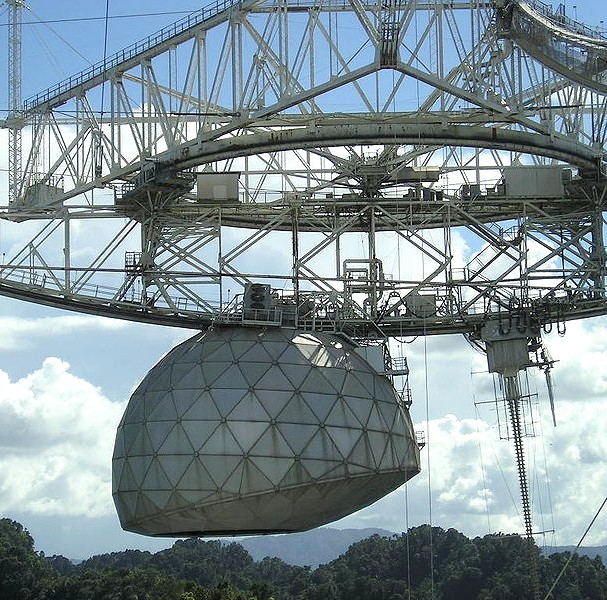
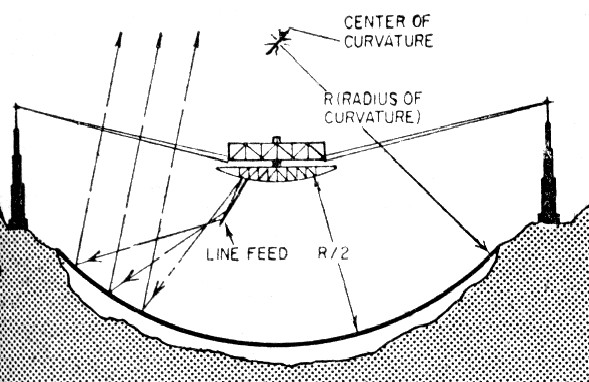
The 1296 station will be located inside the Gregorian Feed Dome
and the
feed horn, will illuminate their dual mirror Gregorian feed, and
then the
1000' spherical dish, 450 ft below. Yesterday we encountered a
problem,
one of space, to mount a planned OM6AA design Dual Mode Feed. We
do not
have much space behind the phase center, to mount the feed, and
dont think
the OM6AA feed will fit. We may only have 18" (still checking)
behind the
phase center point for the feed. We are still testing and
checking, but I
(an EME newbie) would welcome suggestions for feeds that are
particularly
short, that will more likely fit inside the Gregorian Dome on the
rotating
floor, at Arecibo. I am still gathering exact required F/D
information.
We are planning a pre EOA event test of the Arecibo 432 system,
exact time
and date not determined, but probably Feb 24 or 25 from about 0:00
to
01:30 UTC (evenings of the local 23rd and 24th, Arecibo time).
Probably
short, and not aimed at QSOs, in the interest of minimizing
Arecibo Staff
and dish clock time. I will know later if/how many two way QSO
opportunties exist for this test. Principal objective of the test,
is to
see what is required in terms of a minimum station receiver
antenna and
preamps to hear either CW or SSB.
We would like any 432 EME stations to listen, perhaps even record,
signals
received, and send reception reports in, noting their receiver
setups.
Arecibo has more than 50 dbi gain perhaps much more, on 432 (still
seeking
an exact figure) so if it can be heard with modest equipment, I
want to
encourage Hams to connect with schools, set up a 432 receive
system, (or
bring the kids to your EME station) ,and demonstrate EME to the
kids,
during EOA.
We are also looking for a documentarian, to video the Arecibo
visit.
"The most exciting phrase to hear in Science, the one that
heralds
new discoveries, is not "Eureka, I have found it!" but:"That's
funny..."
----Isaac Asimov
_________________________________________________________________
Your E-mail and More On-the-Go. Get Windows Live Hotmail Free.
http://clk.atdmt.com/GBL/go/201469229/direct/01/
_______________________________________________
Moon-Net posting and subscription instructions are at
http://www.nlsa.com/nets/moon-net-help.html
A meeting with NASA at NASA-Ames yesterday bore fruit as earlier
predicted, with an opportunity for collaboration between NASA and
Arecibo,
and possible regular EME operations from Arecibo in the future.
NASA
mentioned, that whether this happens, now turns on a critical EME
receive
test that will happen in March, date as yet undetermined.
The test, which we had hoped to do earlier this week, had to be
postponed
due to operational issues at the Arecibo. NASA and Arecibo would
like a
well organized test done, and, based on the results, will make a
decision
of a level of support and interest for future Arecibo EME/Science
outreach
/ Fun projects. As many as several per year.
What Arecibo, and NASA want, is to
get quality data from as many sources
as possible during the test, and a well thought out, standardized
form for
data collection, and submission for analysis, that includes
details of the
reception, (a digital audio file recording would be great) listing
obviously, time, date, frequency, Make and model, serial number,
of each
item used at the receive location, Receiver, Preamp, if any,Coax,
and
station layout used, Antenna type, make, model, Signal strength
reports,
objective, (precision, if possible) and subjective, and any notes
on how
the antenna was pointed, whether hand held, or some auto track
method.
(software used) A careful record of actual Az and El vs time,
date,
Operator name, location and contact information, and a subjective
report
by the operator after the test. Photographs, or video of each
Station
actually used, or in operation, showing key components, Antenna,
coax run,
interconnects, relays, Receiver preamps used, etc.
It is my guess that with all the highly skilled, and dedicated EME
station
owner operators out here, there are many who have developed their
own
careful note books and forms for documenting their station
performance as
it is constantly improved. If there are any who have developed a
detailed
station configuration and performance report form that is suitable
to be
groomed into a standardized report form for this Arecibo event, we
would
love to see it, and perhaps use it for the event.
Arecibo and NASA would like to
bracket the gamut of stations used, from
the least sophisticated, to the most sophisticated. [Maybe not]
Surprisingly, with particular interest in unsophisticated,
receive-only
stations. NASA and Arecibo really want to see proof that easy to
build,
out of common materials, (welding rod, copper wire, Grape stake or
wood
lath (1x 2s, etc) booms, Stanley Tape elements, etc, antennas that
work,
that are buildable by a, say, middle school age child, under adult
supervison, and ideally, who has a mentor who can work with the
child
showing/teaching/explaining how to use software to determine the
dimensions and spacing of Yagi Elemnts, driven loops, etc. I think
a multi
element Quagi on a variety of lengths of wooden boom would be a
perfect
target home brew antenna, especially if you could A/B compare and
document
that antenna's performance against a (any) commerical, or more
conventional antenna of known characteristics used. I could see a
winning
Science Fair entry coming for someone out of this exercise.
Post test, Data forms need to be
promptly mailed
(e-mail preferred)
in for review by NASA/Arecibo, at a to-be supplied address.
All of these operations, and test at Arecibo are being conducted
in
conformance with operational guidelines, governing operations at
Arecibo,
and US Part 97 FCC regulation.
The frequency suggested for use is 432.045,
subject to change and
confirmed prior to the test. Modes will be SSB, and CW.
Arecibo will use a 432 station lineup provided by the local
Arecibo
Obervatory Amateur Radio Club, capable of providing 60 watts, or
so to
feed. The Arecibo Antenna Gain is about 58 dbi at 432. (!) If
anyone could
loan a higher power PA to the test effort, it would be welcomed.
Time is
now of the essence, for setup prior to the test later in March.
A complete operational, tested, backup 432 EME station, if it
could be
found, and made available at Arecibo, both for the test, and the
event,
April 16,17,18 would be a good idea, and if needed, could be
shipped, or
hand carried, accompanied by the owner-operator who would be the
technical
support component of it's operation at Arecibo. As mentioned
earlier, an
organized sked should be made for the EME event, particularly due
to the
very short (2.5 hour max per day) Arecibo operational windows to
the moon.
We are looking for volunteers for a team to organize skeds.
contact Pat,
AA6EG apolloeme@live.com
for details.
Best Regards,
73, de Pat Barthelow AA6EG
Od: Edward Cole
<kl7uw@acsalaska.net>
Datum: 27.2. 2010, 21:15
Pat,
Couple comments (inserted): Please inform the eme community with
as early
a lead-time as possible for those stations that must install
temporary
equipment (and just general planning).
I'm sure they would like to get data that is comparable (to a
standard
format), and accurate. In fact JT-65 provides this more easily
than SSB/CW
but takes up more time. Perhaps a one-way beacon using JT-65 for
say a
ten-minute test period would allow a lot of stations to record the
signal
with a variety of equipment and antennas. JT-65 produces a
standard signal
level measurement and is capable of producing .wav files of
received
audio.
A data base of participating stations could be built and analyzed
using
VK3UM's sw. That should provide a comparable performance document.
My preliminary eme path-link analysis indicates that you will need
more
than 60w at Arecibo for the small home-built antenna/receivers to
be
successful (especially for SSB). My guess is that a 7-10 element
yagi
(12-dBi gain) would require use of JT-65 for reception of a 60w
transmitter at Arecibo (60w is 14 dB weaker than 1500w; 60w SSB
would be
SNR= -5.4 dB, 60w CW= +1.4 dB). Therefore, obtaining a high power
amp is
very important. I will run my eme path-loss sw to give you an idea
of
ground station requirements for receiving Arecibo with a zero SNR
at
different modes. SSB typically needs SNR= +6 dB, CW SNR> -12
dB, JT-65 SNR
> -28 dB (those are my guesstimates).
73, Ed - KL7UW, WD2XSH/45
Od: Patrick Barthelow
<apolloeme@live.com>
Komu: moon-net@list-serv.davidv.net
Předmět: [Moon-net] EOA, Quagi Antenna Construction Tips,
Datum: 2.3. 2010, 08:42 - dnes v 08:42
Folks:
Assuming the coming pre EOA event (Event: April 16,17,18, pre
event test,
sometime in March) test goes well, there will probably be a series
of
Arecibo moon bounce events organized, in coordination with
Arecibo, approx
thrice yearly, as part of a NASA-Arecibo Ham Radio-EME outreach
program.
and a series of articles covering them, probably in CQ-VHF. "Goes
well"
terminology is critical for success, and is defined as a
successful test
of a small, simple to build 432 Yagi, or Quagi antenna(s) that
successfully receive audio (SSB) trasmissions from the moon.
Recent
meetings with NASA and discussions with Arecibo have empasized the
need
for very careful, scientific rigor in building and documenting the
operational performance of the Quagi antenna of various boom
lengths that
are used for the test. If simple antennas are proven to work
(helped by 58
dbi gain and a KW at the feed) then work begins on arranging
thrice yearly
EME events at Arecibo, with among other things, science outreach
opportunities as the goal.
UHF Quagis, and Quads, have been designed and built in the past,
from
commonly available materials, 12 guage solid house wire, welding
rods
(aluminum, or Brass 1/16") and wood 1" x 2" lath. Perhaps Stanley
Carpenters steel tape fills, (can be bought at a hardware store,
but are
not modeled, so someone needs to model the tape elements, (flat
5/8" wide,
etc) for a Quagi. Should not take more than about 4 hours to build
one of
these, once you pick up the materials from the hardware store.
Well known antenna and Contester Icon, Wayne Oberbeck, N6NB
literally
wrote the book, and landmark articles on Quagis, see below, for
Wayne's
detailed Quagi construction information and tips.
Build some... some as described, some with fewer elements, some
with more
elements and longer booms. follow the prescribed dimensions, and
the
design tips in Wayne's article carefully. I need for the pre-event
Arecibo
test, a number of these kinds of antennas with different boom
lengths, to
evaluate a minimum required design for EME success.
The Arecibo test is later this month, at a to be determined time,
when the
declination of the moon is high, favoring good Arecibo windows.
Prior to
the test event, there will be built Quagi antennas of various boom
lengths, and careful measurements made, on the complete stations
used, and
results obtained. I anticipate a Quagi with a boom length of about
10 ft
will be more than required to hear the Bounced 432 SSB signals. We
would
like to confirm if a much less lengthy boom will also perform
adequately... So, get your materials, this article attached, and
please,
get building!
Best Regards,
73, de Pat Barthelow AA6EG
Od: Patrick Barthelow <apolloeme@live.com>
Komu: john.peters@iae.nl , moon-net@list-serv.davidv.net
Předmět: Re: [Moon-net] Anyone having Experience with Freescale MRF6VP41KH
?
Datum: 11.3. 2010, 13:57
Dear John, and EME Friends,
A timely question, indeed. I am working with Freescale now, and expect
delivery, soon on a 600W output 432 amp, perhaps the first in the field,
for ham radio use. It is in Europe now, at Freescale Semi getting final
detailed adjustments, and bench burn-in testing.
The amp design has been in operational development, for a couple of years
now, and the development engineer says he has extremely high reliability,
with the single KW device package (two FETs).
I anticipate final 432 SSPA checkout, test, and shipment shortly.
We plan to use this at Arecibo. 5 W in, will deliver ~600 W out with high
safety margin, in amateur service. 10:1 SWR withstand capability. Engineer
says that is conservative, and with a proper heatsink, (including water
cooling) says 1KW output is mathematically possible. He says this one that
we are taking to Arecibo at 600W out is operating very safely, and
conservatively at that power level.
A single active device package, 50V switching supply, air cooled heat
sink, 5W in 600W out in a small light package. The amp, we are taking to
Arecibo, will come with a spare MRF6VP41KH device, which can be changed in
the field, with only a screw driver, and some heat sink paste, no
soldering/desoldering necessary. I am truly astonished.
We think a complete 600W output Amp AND switching 50V Power supply can be
packaged < 10kg. I may want to get into building these, for ham use, here
in California. Stay tuned...
Best Regards,
73, de Pat Barthelow AA6EG apolloeme@live.com
Od: Patrick Barthelow <apolloeme@live.com>
Komu: moon-net@list-serv.davidv.net
Předmět: [Moon-net]
Test,
70cm, from Arecibo Possibly Tomorrow
Datum: 18.3. 2010, 20:41
Folks,
Angel at Arecibo is preparing for an operational test at Arecibo, maybe
even as soon as tomorrow, Friday. He and others in the Arecibo Radio Club
have moved quickly on assembling a station, approx 500 watts, and will
position closely to feed, to minimize coax losses.
He has not confirmed the frequency or a mode, or call sign used but it may
be the club Call sign, KP4AO. A frequency that I earlier suggested was
432.045. I will update as soon as I know additional details.
This test is the one I want to get detailed reports on. Please take
careful notes, of your setup and signal strengths received.
Hi Pat,
I'm sure you already reported that, but I wonder what mininimum elevation
is needed at Arecibo to see the moon (mainly I guess by tilting/lifting
the feed as the reflector is a fixed one) ? 70°, 80°, more ? This would
help to compute maximum mutual window at any location, the vk3um planner
is doing this nicely.
Dear Jean-Marc, and Friends,
Arecibo [FK68OI] can steer its beam a maximum of 20 degrees from local vertical,
local zenith angle. That would be entered in VK3UM planner as Minimum
elevation of 70 degrees. Check me on this, but I ran that for today and
find that Arecibo's maximum window in time today, March 19, is from 18:00Z
through 20:40Z. I had planned a number of areas of study, and equipment to
ship and place at Arecibo, such as SDR receivers, High power Amps and
detailed test operations, so as to get a reasonably precise figure of
received signal strength with a variety of antennas.
I had also planned to open up the SWL (schools, radio clubs, and Satellite
ops) population to listening in with simple antennas, especially with high
power at the feed of Arecibo, and ~ 58 dbi of gain. Thanks to Ed, KL7UW
for working with me to run numbers and using exprience to come up with a
minimum antenna/performance required for hearing Arecibo SSB off the moon,
assuming 500 watts at Arecibo Feed. For SSB, it looks like a long boom 20
element, or possibly 2 booms at 13 elements are going to be required.
(Thanks a ton, (or rather about 5 kg) to Lionel, F1JRD, of Freescale
Semiconductor, for his custom designed, single device, 5 in - 600 out
amp.)
Special thanks go to Russ Pillsbury K2TXB who offered to do some event and
QSO scheduling, and to bring an SDR receiver, during the event at the
site.
Remember, this event is only one of the EOA EME/WMBD events (and other EME
(DUBUS)events that weekend. I encourage all to work whatever you can EME
on any band, and have confirmed Dwingeloo participation, and HB9MOON, and
I am guessing some of the guys from Australia, VK3UM, et al, will
participate. Consider that EOA aspects are not limited to 70cm operation.
If you have an idea on how to make a distinctive QSO marker, or content to
the EOA activity, I am interested in hearing suggestions. Perhaps EOA
folks can create at special certificate of participation, or QSL for the
event, for mailing to EME stations or even SWL stations that confirm a
recipt of a QSO.
After Arecibo, I plan to make the Freescale Semi amp ( a backup amp this
time at Arecibo) an EME community "Rover" amp, available to EME
expeditioners, or special ops on 70cm needing QRO. It is an amazingly
capable piece of QRO, lightweight, small, and even capable of higher
power. If.. you can design a water cooled heatsink for the single package
active device. (MRF6VP41KH) I think the whole amp/Switching power supply
package comes in under 10kg, havent seen it yet, it is being prepared for
shipment from France. As soon as I know scheduling of any tests from
Arecibo, I will post.